4 Key questions to ask when you are planning

Every business needs a plan.  In fact, once you have set your goals, you cannot move forward without planning on how to reach those goals.  The better the planning process, the better your results will be.  It is crucial to have a written plan if you want your business to succeed in the long run.

A written plan also helps you achieve the following:

  • It keeps you focused
  • It allows you to make better business decisions
  • It eliminates the feeling of overwhelm
  • It ensures you’re working on the right activities
  • It saves you time by cutting out the time-wasters
  • It gives you a tool to convey to others where your business is headed

When planning for your small business, ask yourself the following questions:

1. Is it affordable?

Finances play a big part in many strategies.  Consider the costs of advertising, transportation, resources, postage, and any other resources you will need for your plan.

2. Is it achievable?

Are the set goals realistically achievable?  Do you really have the money, time, support, facilities, and personnel to achieve the planned outcomes?  It is better to start small and build into a larger project as others join the team and key support is given in other important areas.

3. Is it sustainable?

If your business plan is successful, it is certainly worth repeating.  It may also be the case that your plan is part of an ongoing strategy, in which case you will need to keep looking ahead in order to organise what is needed to sustain your business.

4. Can it be evaluated?

All aspects of your business plan should be able to be evaluated (eg. finances, training, personnel, etc).  For ongoing business activities, definite and regular evaluation times must be set and adhered to.  Also be sure to examine how this venture contributed towards your overall business strategic plan.

Why can Standard Operating Procedures Manuals fail?

When compiling a Standard Operating Procedures Manual, you must keep in mind that people are involved.  You need their cooperation and buy-in in order to achieve a good end result.  They must understand how they will benefit by the whole process.  It is a creative process which involves the cooperation between managers, employees, and advisors.

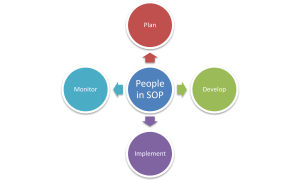
Creating a Standard Operating Procedures Manual is a cyclical process.  It can best be illustrated below.

why standard operating procedures fail

This process includes planning for results, development, implementation, monitoring, and performance feedback.

If you develop a SOP Manual and simply impose it on your employees, your efforts will be futile.  In fact, it is more likely that you will create resentment, rejection of the SOP Manual, and other small acts of sabotage which defeat your purpose.

Everyone who is affected by the SOP Manual should contribute to its development.  If you do not succeed in involving them in the right way, all your efforts are in vain.

Reasons why Standard Operating Procedure Manuals fail to be effective always include the people involved.  Here are examples of the causes for failure

1. Top management is not committed to the process

It is the task of top management, once they decide to create a SOP Manual, to actually follow through and focus the employees’ attention on the goals and benefits of the SOP Manual by communicating with them, and being open to suggestions from all employees throughout the whole process.  If they are not enthusiastic about it, they cannot expect their employees to support it.

 2. Employees mistrust the motives of management

This is a big problem, especially if matters have not been going well between the management and employees prior to the SOP process initiation.  A culture of openness and fairness is far more conducive to producing positive results.

 3. Resistance to change

It can be difficult for some employees to help develop and adapt to new procedures.  They may be very comfortable with the status quo, and not see the need to looking for better ways to do things.

 4. Lack of clear communication

Employees should be informed about the whole aim of creating Standard Operating Procedures before trying to get their input.  They must understand that any input from them is valued, no matter how small it is.  They are, after all, the experts at what they do. They must also feel safe to air problems experienced previously in a procedure, even if it may prove contentious.

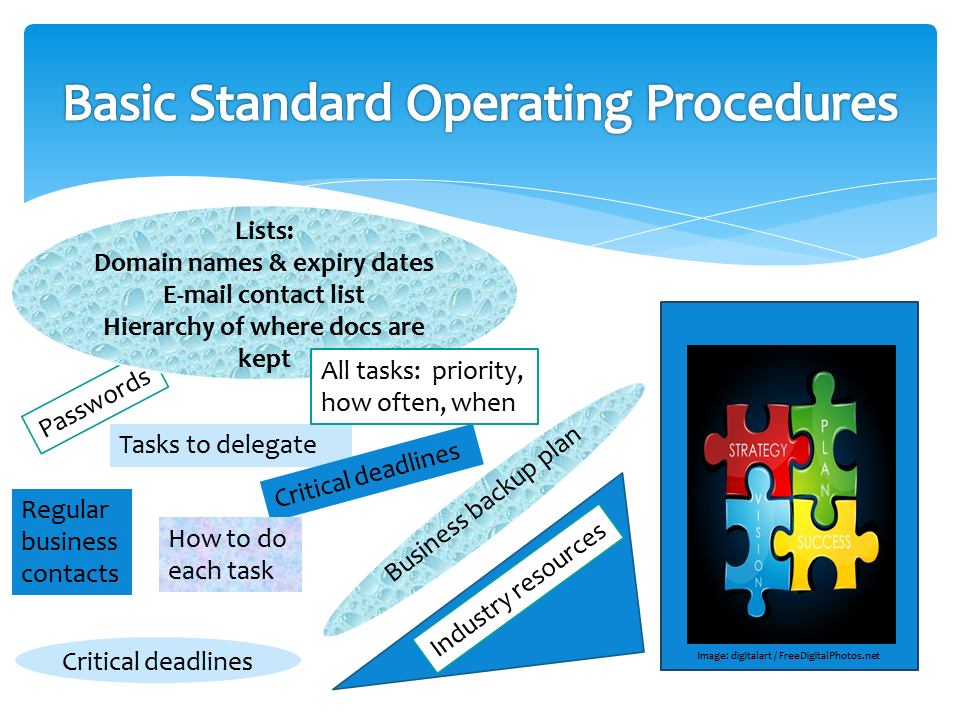
What to include in your business Standard Operating Procedures

Ever wondered what to include in your small business Standard Operating Procedures?

Below is an infographic detailing the basics.


Once your Standard Operating Procedures are compiled, your business will be more productive, because you will not be re-inventing the wheel with each task.

Do you need help in writing your Standard Operating Procedures?  Please contact Virtual Productivity Solutions.  We can consolidate what you have, suggest ways to do routine tasks, and help you create a solid basis for your business.

Contactually: the most practical way to keep on top of your business relationships

I was recently asked to review Contactually, an online tool designed to keep you on track with your customers, potential customers, and other business relationships.

CRMs are incredibly useful tools that, when utilized properly, can be a tremendous asset to an individual, a team, or a company. The problem is that CRMs don’t properly reflect how we work. We interact with them through clunky web applications, and endless forms. We have to remember to feed your CRM more data, otherwise it’s rendered useless.

In comes Contactually, which brings simple, easy-to-use business tools where you need them.  Acting as a personal assistant, Contactually synchronizes with your email accounts and contacts, tracking how you met them, reminding you to follow up, and more.  No software or plugins are required.

It is extremely easy to set up, and integrates with existing CRM software like Salesforce, Highrise, and SugarCRM.  You can also sync your Linkedin contacts with Contactually.  They pull in all your relationships and merge it with your email contacts, so you can see not just who you are connected to, but how well you know them, and when last you talked to them.

From the Contactually dashboard, you can now also do much more than follow up with a contact – you can schedule when to speak to them or record when you contacted them.  You can also keep a task list with dates to be reminded to do those tasks.

When you set up Contactually, you have the option of choosing when to receive your daily email reminders of who to follow up with. This is extremely convenient, because even if you don’t log into the Contactually dashboard, you are kept up to date as to what your next steps should be.

Your contacts on Contactually can be searched via name, alphabetically displayed, displayed according to importance, or displayed according to your last contact with them.  In addition, you can categorize your contacts.  In a similar way to the circles in Google Plus, you can drag and drop your contacts into various buckets, making it so much easier to follow up.

What I really like about Contactually is their excellent customer support.  Not only do they make it really simple to get started, but they keep you updated on new developments and ways to use Contactually.  There is also live support available from your dashboard.

Contactually has also recently become available for teams, giving you the ability to share contacts, collaborate on follow-ups, and ensure that all the external relationships for you and your company are strong.  Staying on top of what your team needs to do helps you make sure you never miss an opportunity.

Claim your first month free to test out their fantastic service by visiting them for instant access.  I can really recommend it.

False assumptions and thinking habits that hinder productivity

We all have false assumptions that have a negative impact on our productivity.  We may not even be aware of what we are doing, but that does not make them any less powerful.  We must recognize these false assumptions that are ruling our lives and make a conscious effort to let them go.

Here are a few assumptions:

  • The more you accomplish, the more worthy a person you are.
  • I’m the only one who can do it right.
  • I can do it all alone.
  • The busier you are, the more people respect you.
  • I’m a failure if my house is a mess.
  • I have to do everything perfectly or it doesn’t count.
  • I can manage time.

A few thinking habits that hinder productivity are:

  • Comparing ourselves to others who seem to be effortlessly productive.  This makes us lose focus of our own priorities.
  • Feeling guilty at all the “shoulds” and “ought to’s” that are not accomplished.
  • Making lame excuses to yourself for not setting up the time to organize your priorities.  Lee Silber said: “Dump the excuses.  They just get in the way of recognizing the important things, setting realistic priorities, and creating the life you want to be living.”
  • Fear of failure.

Warren Buffet said: “Bad habits are like chains that are too light to feel until they are too heavy to carry.” Don’t let your thinking habits become so heavy that your productivity suffers.

When you stop ordering your life in obedience to your personal set of false assumptions and bad thinking habits, you’ll find you have more time for your true priorities.

Take time to identify your false assumptions and bad thinking habits, so that you can address them.  Do you have any that you’d like to share?  You are welcome to add them in the comments section below.

If you need help with determining your priorities and setting goals, please contact Virtual Productivity Solutions. We would love to help you!

Become more productive: 10 tips for managing priorities

Do you want to be more productive?

1.  Plan in detail

Have a planner and write/type everything down in it.  The more you plan, the better you manage and the more you achieve.  The more detailed your plans are, the better.  For me planning works best at the end of the day – somehow my brain rests from trying to remember what all needs to be done and rather focuses on creative stuff.

 2. Begin the night before

After planning the next day, see if there are any small tasks that you can do now to give you a head start the next day.

 3. Deal with today

Focus on the tasks for the day.  If you think of other tasks, add them to your task list and forget about them for the moment.  What you are today is what you are becoming.

 4. Value each minute

Know how long it will take you to complete each task.  Then decide if the task is the best use of your time.  How much is a minute worth?  It is priceless or worthless – depending on how you use it.

 5. Keep moving

The principle of momentum states:  “A body at rest tends to remain at rest, and a body in motion tends to remain in motion.”  Use this law of physics to your advantage.  Try doing just one more thing after you think you are finished, and see how much you can achieve.

6.  Develop a routine

Menial tasks are performed by rote, and you save on energy-draining indecision.  Try to put as many tasks as possible into a routine.  Develop good habits.

 7. Exercise and diet

Studies have shown that exercise increases metabolism, creates energy, causes you to sleep better, and produces pleasure hormones which contribute to positive attitudes, joy in life, and a general lust for life. When you plan your day, put in a slot for exercise.

Diet refers to a way of life.  Develop a dietary way of life that gives you energy and health.

 8. Ask the “half-time” question

“If my life depended on doing this task in half the time I have allotted, what shortcuts would I take?”  Then take them.

9. Use a timer for everything

Parkinson’s Law says:   “Work expands to fill the time allowed for its completion.”  The timer helps you allow less time.  There’s something extremely motivating about hearing your life tick away!

10. Say no

Make your schedule. Let it be Plan A.  Then follow your plan by saying no to yourself and to others.  Move to Plan B only if you realize it is in your best interest to do so because you overlooked something in compiling Plan A.

What is Really Important in Life? A Look at Real and Imagined Priorities

The other day I read a statement made by Benjamin Franklin:  “Drive your business.  Let not your business drive you.”  That got me thinking.

Business people, more than any other group, tend to lack balance in their lives.  Their businesses frequently become all-important, crowding out other priorities such as family, friends, hobbies, and leisure time.  However, keeping our lives in balance is one of the keys to avoiding burnout.  It is also the key to real success in life.

Many business people know how to manage millions of dollars and hundreds of people at work, but fail when it comes to their families, friends, hobbies, and leisure time.  They have let their businesses run them instead of learning to run their businesses.

A typical entrepreneur will tell you the following:  “I always wanted to own my own business because I wanted to be in control of my time.  I wanted to be able to take time off without having to get someone else’s approval.  I wanted to make my own decisions and be my own boss.

“Now I own a successful business.  I have the money to travel anywhere I want to go, but I am so tied down with this business I can’t get away.  I haven’t had a vacation in three years, and it doesn’t look like I’ll be able to take on this year.  I think I work for the business instead of it working for me.”

This statement reflects a life that is out of balance.  He is devoting all his time and effort to the business and making money, and in the process he does not have any time left for himself.

Most business people don’t want to admit their lives are out of balance;  but when a person spends ten to twelve hours a day, six days in his business, his life is unbalanced in favour of business.

What is really important in life?

There are two kinds of priorities:  real and imagined.  We know our priorities are real because we give them our time.  On the other hand, things we talk about doing, plan to do, want to do, but don’t do, are imagined priorities.  Imagined priorities may be written down and discussed regularly, but if we never do them they aren’t actually priorities.

If you want to know what your real priorities are, look at where you spend your time – not what you say or how you spend your money!

Getting your life in balance

It isn’t always easy for business people to keep their lives in balance. Some tips are below:

  • Remove the garbage and insignificant rubble from your daily routine.  Identify the things that are really important and focus on them.
  • Make time for the right priorities.  Unproductive activity is robbing us of time that should be spent on important priorities.  Insignificant activities that take up time but contribute almost nothing to our success must be weeded out and thrown away.  Focus on the significant, letting the insignificant die from lack of attention.
  • Learn to say no to some worthwhile causes.  Most business people are high achievers.  They have a knack for getting things done quickly.  As a result, they are constantly bombarded by people who represent all kinds of good causes wanting “just a little”  of their time.  To have the best things in life, we must practice “selective involvement” – and learn to say no to most of the merely good things. If you don’t know what is most important in your life, you will always wind up doing the things most important to other people.

If you want to know a person’s values, look at his priorities.  If you want to know his priorities, look at how he spends his time.  Your own actions are a statement to others concerning the most important things in your life.

Priorities keep us on track.  They also keep us from getting bogged down in the mire of ineffectiveness.  How far and how fast you travel in life will depend on how faithful you are at developing and maintaining your priorities.

Next steps

  • Evaluate your priorities.  Are they real or imagined?
  • Write out your priorities.  Develop a plan of action for pursuing these goals.
  • Make a list of necessary tasks that you can delegate so that you can spend your time on what is most important to you.

15 Golden Rules to be More Productive

There are many ways in which to increase productivity.  However, we sometimes get so side-tracked with our many daily demands, that we forget to think about them.  Here is a quick reminder of proven tips to increase productivity.


  • Set up a fixed daily routine.  Schedule definite times for routine matters such as meetings, going through the mail, communicating with your secretary, signing letters, etc.
  • Do the things which require maximum brain capacity when you are at your best.  Attend to minor business when your brain cannot cope with anything but small things.
  • Fix deadlines for all jobs.  Stick to them.  A task takes the time set aside for it.
  • Do not postpone important matters that are unpleasant.  You will reduce your creativity and working capacity.  Tasks rarely get more pleasant by being postponed.
  • Put off everything that is not important.  Many so-called problems have a tendency to solve themselves if you ignore them for a while.
  • Analyze your interruptions.  Take steps to avoid them/or diminish their effect.
  • Fix definite times when you do not want to be disturbed.  Hold meetings with yourself.  Put a please do not disturb sign on your door, with a note showing when you are available.
  • Do one thing at a time.  Keep an overview of the next job.
  • Plan your telephone calls. Make a brief note of what you want to say and what you want to find out.  It saves time for everybody and makes for better communication.
  • When you start a piece of work, finish it if possible. If you split it up too much, you lose track of its coherence, lose your overview and waste your time warming up each time you start again.
  • Use definite times/meetings for discussing routine matters with your colleagues.  You then avoid interrupting each other all the time, saving time.
  • Arrange your breaks at times when you cannot work effectively.  For instance when the people you have to talk with are not available, when the material you need is not ready, etc.
  • Be selective.  Learn to say no.  Get used to asking:  “Am I the right person for this task?”
  • Make it a regular rule to check your use of time.
  • Avoid taking work home unless you are certain you will do something about it.  It is much better to work longer at the office until you are finished.  You can then enjoy your leisure time more.

Of course, you can be more productive if you outsource non-core tasks, so that you can concentrate on the things you do best.  Contact Virtual Productivity Solutions for a free consultation to find out what you can outsource virtually, and how you can become more productive.

Are there any trust and proven tips that are not mentioned in this post?  Please feel free to share them below.

Boost your business by creating effective systems


Any business owner will be able to tell you that a business built on effective systems is far more successful than one that is not.

The Business Directory defines a business system as a methodical procedure or process that is used as a delivery mechanism for providing specific goods or services to customers.

Creating effective business systems can be challenging for small business owners.  You may not have the time or inclination to develop systems.  However, if you are serious about business growth, you could consider outsourcing this function to someone that is knowledgeable in this area.  Alternatively, if you have enough in-house staff, you can delegate it to someone that is detail oriented, analytical, persistent and creative, and who does not have a full-time work load.

What would outsourcing your systems management entail?

  • Your key performance indicators will be identified
  • Areas of reduced productivity will be identified
  • Opportunities for improvement will be suggested
  • Your process documentation will be created (checklists, flowcharts, etc) to support the opportunities for improvement
  • You as business owner will approve all processes before they are released
  • Your staff will have an opportunity to contribute to these systems, and also be trained on how to use these systems once they are approved
  • Data will be collected data to monitor your key performance indicators
  • You will receive a reporting scorecard each month on how your business measures up to these key performance indicators.

How to keep on top of your systems development and implementation once you outsource it

  • There needs to be open communication and trust between you and the person working on your system
  • While a lot of the development and detail of creating systems is outsourced, as the business owner you are still responsible and accountable for what happens with regard to systems and processes.
  • A weekly status meeting will go a long way in helping you to catch up with what has been achieved, what has gone well, or areas where challenges or issues have developed.

The results of outsourcing systems development and implementation

  • You will have more time
  • You will increase your competitiveness
  • You will reap the financial rewards of the working systems and procedures
  • Your staff will be happier because they know what they are supposed to be doing
  • Your customers will be more satisfied at your consistent service and output
  • Your business continuity is ensured, because anyone can do the urgent tasks according to the set out procedures if a key staff member is ill or on leave.
  • You will be able to take your business to the next level because your systems and procedures are working.

Next steps

If you would like to find out more about how to improve your business systems, or if you are interested in outsourcing this function, please contact Virtual Productivity Solutions.  We will gladly assist you in this regard.

Your Top 5 Virtual Outsourcing Problems – Solved!

This blog post is written for small business owners who are convinced that virtual service outsourcing is the right route to follow as the next step towards their business success.

Although there are significant benefits to outsourcing (see The Top 8 Ways Small Business Owners can Benefit by Outsourcing), some problems may be experienced that you may not be prepared for.

1. Ineffective communication

This is the largest problem when it comes to outsourcing.  The importance of effective communication cannot be overstated.  There may be natural communication barriers such as language barriers or cultural differences which need to be considered.  But even in the same culture and with the same mother tongue misunderstandings can occur.

Steps to avoid communication problems include:

  • State your expectations explicitly in the contract.  You need to spell out your exactly what you envisage and how your virtual service provider will meet them.  This is not a time to provide broad guidelines in an attempt to allow for flexibility.  Be very specific.
  • Schedule a weekly Skype chat, or something similar based on your needs, in which detailed report-backs can be given by your virtual service provider.  You can give immediate feedback and discuss problems experienced and potential solutions.
  • Expect daily contact either via phone, e-mail or web portals from your virtual service provider to keep you up to date on progress, any problems experienced, etc.  A good idea is to have a project management platform on which all information is shared, so that all the relevant parties have access to it.

 2. Outsourcing before you are really ready for it

You need to prepare and plan to outsource before actually doing it.

  • Make a list of what your needs are and how you envisage outsourcing will address these needs
  • Think about your small business’s strengths and weaknesses, and look for someone who will complement these.
  • Decide who will be responsible for managing the virtual service provider.
  • Do you have an outsourcing strategy?  If not, this is a good time to compile one.  It is difficult to succeed without a written plan.

 3. Having unrealistic expectations

Outsourcing will not solve all your business problems overnight.  You are ultimately responsible for your small business’s success.  A few points to remember are:

  • Your virtual service provider does not know everything about your business that you do.  They will function better as they gain more insights into how your business works, and how you like to operate.  Be open about your business and share whatever information is necessary to achieve their optimum performance.
  • Although most virtual service providers are professionals who will hit the ground running, you may have to provide some training or guidelines in certain aspects of the work you expect them to do.

 4. Choosing a virtual service provider for the wrong reasons

Going for the cheapest option can lead to disaster.  Although it makes sense to get a few quotations before choosing someone, keep the following in mind:

  • Ensure that the virtual service provider is able to meet your specific needs.
  • When comparing quotes, make sure that you are comparing apples with apples.
  • Evaluate the potential service providers’ responses to your queries.  Are they enthusiastic?  Do they follow up within a reasonable time?
  • More pointers to find the right service providers for your needs can be found in my article 6 Steps to Find the Best Online Workers.

 5. Providing unclear specifications

Take time at the beginning of your working relationship to ensure that your specifications are thorough and accurate.  This will save trouble later.  For instance, if you realize only after starting a project that you need to change the scope, you will affect both your cost and the time it will take to complete it.

Start a positive outsourcing experience today, and see what a difference it can make to your business success.  Whether you need to outsource administrative tasks or human resource related tasks, feel free to contact Virtual Productivity Solutions to make your outsourcing experience a positive and unforgettable one!