Why Most Founders Don’t Have a Growth Problem but an Operational Maturity Problem

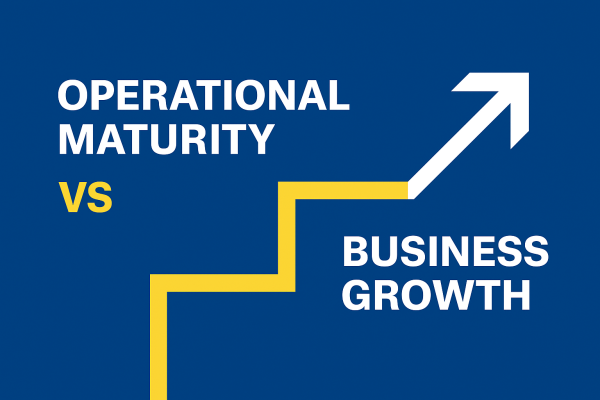
Illustration showing operational maturity compared to business growth, designed in blue and yellow with upward and sideways arrows.

Growth is rarely the real issue inside founder-led businesses.

In fact, most companies don’t struggle because of demand, market fit, or talent.

They struggle because their operational maturity isn’t keeping pace with their revenue.

And almost nobody names this accurately.

The Real Pattern Inside Scaling Businesses

After working with numerous founder-led agencies, service businesses, and hybrid teams, the same signals appear again and again:

    • Revenue grows faster than clarity

    • The founder inadvertently becomes the default decision-maker

    • Tools multiply, but workflows don’t evolve with them

    • Delivery quality changes depending on who’s working that day

    • Teams stay “busy” but progress feels slower, not faster

None of these are signs of a failing business.
They’re signs of a business whose operations haven’t matured to support the next stage of growth.

It’s Not a Delegation Problem

One of the biggest misconceptions is that founders just need to “delegate better.”

But delegation only works when:

    • workflows are clear

    • expectations are defined

    • accountability is structured

    • systems support the work

Without this foundation, delegation only creates more complexity, rework, and decision bottlenecks.

This is why so many founders feel they’re still carrying the business — because, in reality, they are.

The Real Issue: Operational Maturity

Every business operates at a certain maturity level.
Most founders believe they’re working at Level 3 or Level 4.

In reality, many are still at Level 1 or 2.

What happens when operational maturity is low?

    • Projects stall near the finish line

    • Data becomes unreliable or incomplete

    • Small issues turn into large ones

    • Team members ask for clarity repeatedly—or stay silent

    • Decision-making keeps circling back to the founder

    • Growth feels increasingly heavy

What happens when operational maturity increases?

    • Projects finish

    • Delivery becomes predictable

    • Team members take ownership

    • Leaders spend more time on strategy, less on fire-fighting

    • The entire business gains speed and stability

    • The founder finally steps out of the weeds

Raising operational maturity is the moment where the business stops running on founder effort—and starts running on structure, systems, and clarity.

Introducing the 5 Levels of Operational Maturity

To help founders diagnose where they truly sit, I created the 5 Levels of Operational Maturity — a simple but powerful model that explains:

    • why things feel heavy

    • why growth stalls

    • why systems break

    • what needs to change to scale sustainably

The model outlines how businesses evolve from:

    1. Founder-as-Operating-System
      → to

    2. Inconsistent Process Awareness
      → to

    3. Defined Systems & Workflows
      → to

    4. Data-Led Delivery
      → to

    5. Operational Autonomy

Each level reflects a different set of capabilities, limitations, and growth ceilings.

Most companies don’t fail because they hit a revenue limit.
They fail because they hit an operational maturity limit.

Want to Know Your Level?

I created a companion tool — the Operational Maturity Scorecard — to help founders understand exactly where their business sits across the five levels.

The scorecard highlights:

    • your operational strengths

    • your bottlenecks

    • the specific maturity level holding your business back

    • what to fix first

If you’d like the scorecard, feel free to send me a message, and I’ll share it with you.
Why Most Founder-Led Businesses Don’t Need a COO

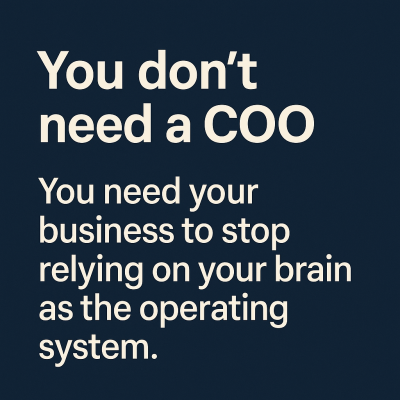
“Operational clarity for founder-led businesses — you don’t need a COO, you need systems.

You Don’t Need a COO. You Need Your Business to Stop Relying on Your Brain as the Operating System

A founder told me recently:

“I don’t think I need a COO… I think I just need to stop running the whole company from my head.”

We had been mapping out his workflows, walking step by step through how work really moved through the business. And every few minutes, he paused, frowned a little, and said the same thing:

“Oh… yeah… that part lives with me.”

Lead distribution?
In his head.

How the team knows what to do on Mondays?
In his head.

How sales hands off to delivery?
Also in his head.

How the business actually generates revenue?
Still in his head.

His team wasn’t inexperienced.
His systems weren’t broken.
His business wasn’t in trouble.

It was simply operating on a single point of failure: the founder’s memory.

And the weight of that finally hit him.

Most founders don’t need a COO.
They need operational clarity.

The Real Reason Founder-Led Companies Hit a Ceiling

Founder-led businesses grow quickly because they rely on the founder’s speed, intuition, and adaptability.

And they hit a ceiling for the exact same reason.

Here’s what we uncovered inside his company—patterns I see in almost every scaling team:

    • Work gets done, but everyone follows a different process

    • Ownership feels unclear, so accountability slips

    • Projects move, but not predictably

    • Dozens of decisions flow back to the founder each day

    • No one can confidently describe how work is supposed to flow

    • Systems exist… but none of them talk to each other

He wasn’t overwhelmed because the business was growing.
He was overwhelmed because the business wasn’t designed to grow.

When your business runs on memory instead of systems, the founder becomes:

    • the bottleneck

    • the glue

    • the problem-solver

    • the project manager

    • the decision engine

    • the safety net

    • the default leader of every team

No COO hire can fix that.

If anything, it creates a more expensive version of the same issue.

Operational Chaos Is Not a Leadership Problem. It’s a Design Problem.

Before you think about hiring a COO, you need a foundation that removes the founder as the operating system.

This includes:

1. Documented, clear workflows

So everyone understands the process—and follows it the same way.

2. A single source of truth

One central place where decisions, data, and information live.

3. Clean handoffs

Sales to delivery. Delivery to support. Support back to operations.

4. Clear roles and expectations

Everyone must know what “good” looks like in their role.

5. A reliable onboarding engine

New team members should become productive without founder dependency.

6. A predictable weekly cadence

Meetings, reporting, and priorities must run like a rhythm, not a reaction.

7. Delivery systems that don’t rely on heroic effort

Success cannot depend on hustle, memory, or personal interpretation.

When these elements are in place, everything changes:

    • The founder stops being the bottleneck

    • Teams become confident and independent

    • Decisions speed up

    • Accountability increases

    • Delivery becomes consistent

    • Growth becomes repeatable

This is the transformation my client experienced.

Shortly after building this backbone, he told me:

“It feels like I’m finally running a business, not babysitting one.”

And he meant it.

Most Founder Problems Are Not People Problems—They Are System Problems

Founders often believe:

    • “I just need better people.”

    • “I need a COO to take this off my plate.”

    • “My team should be more proactive.”

But the truth is simpler:

People cannot excel inside systems that don’t exist.

You don’t need a COO to create clarity.

You need operational design that allows your team—and your future COO—to perform at a high level.

The title can come later.
The foundation must come first.

If This Sounds Familiar, You’re Not Alone

Most founders eventually admit the same thing my client did:

“My business runs on me. And that’s the real problem.”

You’re not failing.

Your systems just haven’t caught up to your growth yet.

So ask yourself:

What is one thing your team still relies on you for that you wish they didn’t?

Start there.
That’s your first operational leverage point.

Unsustainable Scaling Warning Signs Every Founder Should Recognise Early

Close-up of a cracked concrete wall symbolizing early warning signs of unsustainable business scaling.

Unsustainable scaling warning signs often show up long before a business hits a breaking point — but most founders don’t recognise them for what they are.

You may see rising revenue, growing demand, and a busier team… yet underneath the momentum, cracks begin to form in your systems, workflows, and decision-making. These early indicators are the real predictors of whether your business will scale smoothly or collapse under its own growth.

Most founders only realise this when something finally collapses: a key hire quits, a high-value client churns, or delivery buckles under pressure.

The truth is that the signs show up much earlier. You just need to know what to look for.

Below are the most reliable indicators that a business is scaling—but not sustainably, based on my work stabilising operational chaos in startups, agencies, and specialist service businesses.

1. Decision Time Quietly Doubles

You used to:

    • decide

    • execute

    • move on

Now every decision requires:

    • multiple messages

    • context checks

    • a meeting

    • a follow-up meeting

This is known as the coordination tax of scale, and research consistently links it to slower organisational growth and lower execution efficiency.

When decisions take longer, momentum dies—and with it, the speed that made your startup successful in the first place.

2. Revenue Is Up, But Your Team Is Exhausted

This is one of the clearest indicators of unhealthy scaling.

Studies on fast-growth companies show a direct link between:

    • rapid scaling

    • increased burnout

    • declining role clarity

    • reduced job satisfaction

If your team is working harder, not smarter, you’re adding revenue on the back of human strain instead of a scalable operating model.

That is growth through brute force—not growth through systems.

3. New People Can’t Figure Out “How Things Work”

High-performing companies that scale well introduce:

    • functional experts

    • documented processes

    • predictable decision rules

    • clear ownership structures

If onboarding still feels like a “founder brain-dump,” the business is simply a larger version of its early-stage self.

This creates:

    • inconsistent delivery

    • dependency on tribal knowledge

    • bottlenecks around whoever “knows the story”

A scalable business transfers knowledge faster than it hires.

4. The Same Problems Keep Coming Back

Every business has problems—but in a healthy scaling environment, the problems change over time.

If the same issues resurface:

    • missed handovers

    • unclear ownership

    • rework

    • client delays

    • internal misalignment

…it’s a sign you’re relying on people to compensate for broken processes.

Growth amplifies whatever wasn’t working before.

5. Everything Still Routes Through the Founder

This is classic Founder’s Syndrome—a natural and common pattern where the founder remains the operational centre of gravity far beyond what the business can sustain.

Symptoms include:

    • founder approves everything

    • founder solves the same problems repeatedly

    • founder is the escalation point for all decisions

    • founder can’t take a real break

    • the team stalls waiting for direction

A business that cannot run predictably without the founder cannot scale predictably.

These Issues Don’t Mean You’re Failing — They Mean You’re Growing Without an Operating System

There is nothing wrong with growth bringing friction.
What is dangerous is assuming the friction will solve itself.

It never does.

Sustainable scaling requires:

    • a clear operating rhythm

    • simple, documented workflows

    • defined ownership and decision rights

    • automation where appropriate

    • a structure that supports the founder—not the other way around

This is the work I do with founders every day: moving them from improvisation to infrastructure, from reactive operations to predictable performance.

If these signs feel familiar, here’s your next step

If you noticed three or more issues in this list, your business is likely scaling on talent and effort—not systems.

That’s fixable.

You can book a Clarity Call with me here:
https://calendly.com/sonjavorster

On the call, we’ll walk through:

    • what’s working

    • what’s breaking

    • what’s preventable

    • and the exact steps to install a calm, scalable operating system in the next 30 days

No pressure.
No fluff.
Just clarity.

Streamlined Recruitment and Onboarding for Contractors | Case Study

business workflow

Client Background

A fast-growing SaaS agency was entering a rapid hiring phase requiring multiple independent contractors across departments. The company needed a scalable and efficient recruitment process to keep pace with growth while delivering a consistent candidate experience.

The Challenge: Inefficient Hiring and Onboarding

Before partnering with Virtual Productivity Solutions, they faced several challenges:

  • Manual and inconsistent recruitment processes, causing delays in hiring critical roles.

  • No centralized system for managing candidates across LinkedIn, their CRM, and the company website.

  • Unstructured onboarding, resulting in inconsistent new hire experiences.

  • Repetitive tasks consuming internal teams’ time, preventing focus on strategic decisions.

They needed a solution to implement streamlined recruitment and onboarding for contractors, improve candidate quality, and free up managerial time.

The Solution: Optimizing Recruitment and Onboarding

Virtual Productivity Solutions partnered with them to implement an end-to-end recruitment and onboarding framework.

Discovery & Workflow Mapping

We documented their existing workflows to identify bottlenecks and inefficiencies in recruitment and onboarding.

Process Optimization

We designed a To-Be workflow that leveraged automation, best practices, and scalable processes to ensure consistent hiring outcomes.

Systems Setup

ClickUp pipelines and HubSpot candidate tracking were configured, including AI-enabled screening to streamline the hiring process.

Talent Acquisition Support

We assisted with drafting job posts, monitoring applicant flow, shortlisting candidates, and conducting first-round interviews to speed up recruitment and ensure quality.

Structured Onboarding Implementation

SOPs, onboarding checklists, buddy programs, and 30/60/90-day review milestones were introduced, creating a consistent onboarding experience for contractors.

Results & Impact in the First Month

After implementing the new system, they achieved:

  • Reduced time-to-hire with structured recruitment pipelines.

  • Improved candidate quality through standardized vetting and scorecards.

  • Consistent onboarding experience for all contractors.

  • Freed managerial time by automating repetitive recruitment tasks.

  • Scalable processes, enabling multiple contractors to be onboarded simultaneously.

Conclusion: Scalable Contractor Hiring Made Easy

By implementing streamlined recruitment and onboarding for contractors, this agency set the foundation for rapid growth and operational efficiency. This case study demonstrates how structured workflows, automation, and clear SOPs can transform contractor hiring, improve candidate experience, and create scalable processes that grow with your business.

Intuition: an essential but sometimes elusive skill

What gives some business leaders the uncanny ability to make the right decisions? Is it something that you can acquire or learn or is it just a feeling that you act on? What role does intuition play in your business?

Henry Cloud said: “Intuition is knowing without knowing how you know. Intuition is your “gut response.” The most successful and high calibre leaders listen to their intuition.” and Alexis Carrel said: “All great men are gifted with intuition. They know without reasoning or analysis, what they need to know.”

In my opinion, intuition is an extraordinary skill which is based on our value systems combined with our experiences which is constructed over a period of time. In other words, your intuition is continually developing if you allow it to. It is not an intellectual thing per se, but rather a heart feeling. This “feeling” allows you to see what others may have missed and also helps you make decisions that are best for your business. Of course, decisions should never be made on feelings alone, but using your intuition as a part of evaluating your next course of action can help you make better decisions.

I believe everyone has intuition, but we often ignore our intuition as we are distracted by the many things going on around us. Some people might also scoff that which they don’t understand or cannot explain in a purely rational way.

If you believe that intuition is important in your business and life, how can you focus on it or refine it?

  1. Evaluate your value system.

What are you values based on? How were they shaped? Do you need to re-evaluate your values?

  1. Evaluate your previous experiences.

What worked? What didn’t work? How did you intuitively feel about each experience as you were going through them? Did you know in advance whether or not they would work (or not work?)

  1. Take a step back.

When you face a situation, don’t only focus on facts. Don’t focus on all the distractions or how you think you should respond. Rather think how you feel about the whole situation, person you meet with, or decision at that moment.

  1. Keep a journal.

Take time (once a day is great) in which you reflect on what you have encountered during the day and how you feel about things. Writing things down helps you solidify and clarify- your thoughts.

  1. Practice intuition.

Just like any skill, intuition is refined with practice. The more you listen to your intuition, the easier it becomes to be aware of it and to use it.

An Overview of Apps to Use to Document Your Standard Operating Procedures

Having your Standard Operating Procedures in place is the only way in which you can ensure consistency and grow your business. However, it is often perceived as a difficult and time-consuming task to compile Standard Operating Procedures, especially in the light of them not staying the same over time due to improvements.

Fortunately, there are some clever people who designed easy ways to compile and maintain Standard Operating Procedures online and on the go.

Process Street

This is a really simple way to manage recurring workflows for your team.

You can set up templates that can be used over and over. In addition, it allows you to track your team’s progress on each workflow so that you can see at a glance.

There are wonderful templates available so that you can set up your processes easily and quickly.

It integrates with over 500 apps, which is great if there are some apps you are already working with.

You can start out with a free plan for up to 5 templates.

SweetProcess

SweetProcess has a 14 day free trial, after which it will cost you $99/month for up to 20 active members.

Like Process Street, it offers you a way to document your procedures and track your team’s progress on them. You can also export your procedures into an Excel or PDF file.

Pipefy

Pipefy offers a little more than Process Street and SweetProcess. Not only can you document and track the progress your procedures with templates provided, you can set up a seamless flow between your different business processes.  You can create templated emails and send them out from Pipefy. In addition, you can create a database for your company’s information. The paid version also offers you the ability to create powerful reports based on your processes.

Small teams (up to 10 users) can sign up for free to begin their workflow controls. However, if you need all Pipefy’s features to grow your business, it costs $30 per user per month. Additional plans for larger teams are available as well.

Of course, if you just want to compile standard operating procedures for reference and easy edits, you can also use tools such as EvernoteWunderlistWorkflowy and Trello.

If you need help in setting up any of the above apps and capturing your workflows and processes, please don’t hesitate to contact me. I’m passionate about setting up and effectively using standard operating procedures!

Bitrix24 – A Recommended Business Management Tool For Real Estate

A real estate client of mine needed a business management tool that would enable her to have a birds-eye view of her business and at the same time help her business grow. I recommended Bitrix24.

Bitrix24 is easy to learn and intuitive. Anyone who uses social media like Facebook or Linkedin should have no problems learning it.

She started by explaining to me what processes are followed in the business. When a potential seller contacts them, they do a free market evaluation in order to determine the value of the seller’s property. If the seller decides to list, the property is advertised for a year. If the property has not sold during that time, the seller needs to sign documentation to relist the property. If there are buyer queries, there is a procedure to be followed to match the right buyer to the right seller. There is also a procedure for closing a sale.

Using Bitrix24, I set up automatic lead captures for the free market evaluations from her website. I then wrote and set up the procedure which is followed to do the market evaluation to ensure that each market evaluation is done in the same way. I also wrote and set up an automatic series of follow-up emails to ensure that the lead is kept engaged with the company until they decide to list.

Once the potential seller decides to list, I wrote and set up the procedure on how to handle a new listing. I also set up a reminder system for follow-up with the seller at set intervals after they listed their property. In addition, I set up a reminder system to alert them to when their listing agreement is due to expire and if they don’t renew, to send them an expiry notice. Again, if a seller’s listing expired without them taking action to renew it, I wrote and automated the email follow-up with them to encourage them to list with us again.

With Bitrix24, it is also easy to generate reports on the number of new listings received during a particular period, how many sales were made, how much commission was earned, the average days a listing is on the market before it sells, the growth from year to year, etc at the click of a button.

Another advantage is that when each employee logs onto Bitrix24 every morning, there is a complete list of what they should be doing during that day with deadlines attached. This ensures that no tasks can fall through the cracks. It is also very easy for employees to communicate with each other using Bitrix24, eliminating the need for back and forth emails or meetings.

This year to date there has been an increase of over 50% compared to last year in the number of sales made, which is very gratifying. The number of people that have chosen to list with us has also increased dramatically with the automatic follow-ups.

There are other useful features in Bitrix24 which I haven’t covered here which have definitely helped to streamline her business.

I believe Bitrix24 can be customized easily to fit any kind of business. However, customizing it for a real estate company has worked extremely well with excellent results.

Statistics: Why I believe we should use more than statistics when working with people

I recently had someone ask me to provide the statistics regarding the reduced learning curve and saved time a standard operating procedure manual can provide for new employees.

Mmmm….

When people request statistics on something, they miss out on the big picture. I agree that it would be easy to attach a percentage to, for instance, a reduced learning curve.

But what are we missing when we blithely quote statistics and percentages when it comes to employees?

We miss the big picture.

I can go and measure the reduced learning curve in an organisation that has a standard operating procedure manual. It is not that difficult to do. But this measurement will differ from organisation to organisation and even from person to person. Why?

Because there are so many other factors to consider. What is the quality of the standard operating manual? Is it easy to understand? Does it cover the exact learning that is to take place? What is the intelligence of the new employee reading the manual? Is reading their preferred learning style? Is the new employee in an environment conducive to learning?

So I ditch the statistics in favour of general conviction. If I look at studies done and find that a certain method works better than another overall, I adopt the better method. I don’t need statistics to make my choice.

If President Truman had waited for all the statistics to be presented to him before authorising the atom bomb to be used during World War II, he would have waited 2000 years, even if the whole USA civil service was gathering and collating this data. He based his decision on a general conviction, based on all he knew, that it was better to authorise it than not to.

When you meet up with someone and decide you would like to get married to them, do you need statistics for your choice? I know a person who compiled a list of his ideal soul mate and didn’t get married until he threw away his list!

Let’s step back and look at the big picture. Let’s consider statistics, but not make it the determining factor in making decisions regarding people.

Systems: 3 Excuses for not setting them up

Creating systems in your business are crucial for survival and success, yet so many of us never get down to getting these into place.  We spin our wheels and get distracted and remain super busy, exhausting ourselves in the process. We are overwhelmed and our businesses suffer for it. Are you guilty of holding yourself back with any of the following excuses?

I read a while back that an excuse is just a lie we tell ourselves in order to feel better about not achieving as we should.

Excuse 1: Setting up a system is an overwhelming, hopeless chore

Reality: Setting up a system creates an ordered process. Once you have mastered a system, it becomes an exhilarating way of freeing yourself up and maintaining a steady course in a complex world. You may even consider it fun because it produces a gratifying sense of clarity, focus and accomplishment.

Excuse 2: It is impossible to stick to a system

Reality:  This could be true. It is impossible to stick to a system if…. your system is a poor fit for you and maintaining it is a difficult chore.

However, a well thought out system is sustainable. If you build your system around the way you think and design it to grow and adapt around your changing needs it will serve you for years to come.

Excuse 3: Creating systems is a non-productive use of time

Reality: You may feel that it would be more productive to call on customers, attend meetings, to write a proposal or even to catch up on your sleep.

In our fast-paced environment with more and more demands on our time and ability to make choices, those who have systems will thrive.  Those without systems will be disorganised and overwhelmed, unsure of which way to turn.  Eventually, they will flounder.

You cannot afford not to have business systems.  They are indispensable tools to keep you on track and to help you automatically execute tasks or outsource them so that you can focus on the more interesting aspects of your business.

How to Set and Achieve Your Goals for Lasting Success

achieve your goals

Why Successful People Always Set Goals

Research shows that one of the biggest differences between top achievers and everyone else is goal setting. The most successful 10% don’t just have goals in mind—they write them down.

Most people dream of more than they will ever need, but because they don’t know how to set realistic, actionable goals, they achieve far less than they could.

Why Do So Few People Set Goals?

There are three main reasons why most people never set or achieve their goals:

  • They’ve never been taught how. Many have experienced the small satisfaction of achieving a short-term target, but don’t realize the life-changing impact of consciously setting goals.

  • Fear of failure. Some avoid setting goals because they’re afraid of failing. What they don’t realize is that even the highest achievers are ordinary people who worked persistently toward success.

  • Procrastination. We often “intend” to set goals or change our lives, but never take action.

How to Set and Achieve Your Goals

If you want to grow your business, increase income, or simply live with more purpose, you need a clear system. Here are five proven measures to set and achieve your goals:

  1. Define your goal clearly.
    Vague goals like “I want to earn more” don’t work. Instead, set specific, measurable goals such as: “I want to increase my business revenue by 25% this year.”

  2. Make it believable.
    Your goals should challenge you but also feel achievable with the right plan.

  3. Fuel it with desire.
    If you don’t strongly want it, you won’t stick to it. Motivation comes from setting goals that genuinely matter to you.

  4. Create a detailed plan.
    Break your goal into smaller steps, set deadlines, and prepare resources or budgets. Learn from others who’ve achieved similar success.

  5. Visualize the benefits.
    Imagine what life will look like after you’ve achieved your goal. This visualization keeps motivation high when challenges arise.

Start Small, Build Momentum

Getting started is often the hardest part. Begin with small, manageable goals to build confidence. Each small win fuels your motivation for bigger achievements.

Even completing simple unfinished tasks can give you more energy. For example: tidy your workspace, clear out your car, or finish household chores you’ve been postponing. Completing cycles restores mental clarity and momentum.

Practical Exercise

This weekend, make a list of tasks you’ve been avoiding. Estimate how long each will take, decide when you’ll do them, and then complete the list. You’ll be surprised how much lighter, focused, and energized you feel.

The Bottom Line

If you want long-term business or personal success, you must learn to set and achieve your goals. The process isn’t difficult, but it requires clarity, planning, and commitment. Once you master it, success is no longer a matter of chance—it’s a guarantee.