How to Get the Best Out of Your Relationship with Your Virtual Assistant

Previously we look at the 3 Essential Steps to follow before hiring a VA as well as How to ensure you hire the best VA for your business.  This week focuses on starting your working relationship with your virtual assistant.

Once you have appointed your Virtual Assistant, it is important to have realistic expectations.  You both need to adjust to working together.  Plan for a trial period and gradually inch your way into outsourcing.

Learn when to outsource to a virtual assistant and when it’s faster to do it yourself

It’s almost always faster to do it yourself if it is a one-time thing.  If it’s a repetitive task, it’s probably worth training the VA to do it.

Communicate clearly with your virtual assistant

Clear communication cannot be emphasised too strongly.

No one knows your business as you do. Communicate clearly and often with your VA and make adjustments as you go.

At the start, let your VA know what your goals for your business are and how you intend to use their services to best support your needs.

First, assign the tasks including all the relevant information and clear and concise instructions that will contribute towards the success of the project.  Be sure to indicate your deadlines – most Virtual Assistants need a 24 – 48-hour time frame to complete assignments, so plan accordingly.

Provide your contact information and indicate the best way to contact you.

Provide training where necessary for your virtual assistant

Although your VA is a professional business person, it is a good idea to schedule some one-on-one training to help him/her to understand how you like things done.  This also gives the VA a chance to ask questions

Create a manual of key processes for your virtual assistant

This works especially well with repetitive tasks.  It will speed up the training process as well as provide a benchmark for a job well done.

Expect an accounting of the time spent on your business

You don’t have to micromanage your VA, but it is reasonable to expect a summary of the week’s accomplishments or tasks completed, as well as any problems the VA may be experiencing.

Make use of online collaboration tools

Dropbox

This is an awesome tool with allows for online backup, syncing, and file sharing.  It is super easy to share important documents like marketing materials, digital signature files, contracts, and more.

Google Docs

Google Docs provides a free online word processor, spreadsheet, presentation, and form service that makes collaboration a cinch.

Jing

It allows you to quickly create training videos (including screen captures) on various things you need your VA to do.

Skype

Skype allows you to have quick chats, phone calls, and video calls with ease. If you need to record your Skype conversation, there are free tools like MP3 Skype Recorder.

Asana

Asana is a great online productivity and organisation tool.  It allows you to create projects and tasks for your VA, and to track progress in real-time.

TimeTrade

This is an online appointment scheduler with automatic reminder and Outlook and Google Calendar integration.  You can simply provide people with your own personal URL so that they can set up an appointment based on your calendar availability.

Before long, the work will now get done that you didn’t have time to do before. It feels great when you actually have time for yourself.  Maybe with the extra time you have created by working with a VA, you can plan for that much-needed vacation – No, wait.  Your VA can do that for you too!

How to make sure that you hire the best Virtual Assistant for your business

Last week we looked at the 3 essential steps to follow before hiring a virtual assistant.

This week’s post is about what to do once you have received responses to your advertisement.

Once you have sent out your advertisement or request for proposals, you can start evaluating the responses you get.

Beware of responses with resumes attached.  A VA is your business partner, not your employee, and those sending a resume may still be in “employee” mode.

If you posted an ad asking for very specific information, the VA should respond answering all your questions.  If they fail to do so, you can assume that this VA does not take the time to read basic instructions and will often forget minor details that contribute to the successful completion of any task.

Also, search for grammatical errors in the responses.  You need a professional who can effectively write and convey their message.  You never know when you may need your VA to write an email on your behalf, or to help with proofreading or content creation.

Once you narrow your selection, it’s time to dig into the details.  Most VA’s have an online presence. Is their site polished and professional or does it look like a butchered template from the ‘90s seasoned with poor grammar?  It may sound a bit biased to judge them on their site’s appearance, but you have to take into consideration they are a business owner just like you.  If they have a strong online presence free of inaccuracies and errors, it clearly indicates that they are committed to this profession in the long run.

Do a Google search on the VA’s name.  What image does this person portray?  Do they broadcast the most intimate details of their personal lives to the world, or is their communication meaningful and professional?

Think about what you want the VA to do for you. For instance, if you want your VA to help you maintain your social media profiles, what does theirs look like?  It will give you a good indication of the type of support you can expect to receive from them.

Conducting an interview

The ideal is to find a long-term collaborative partnership in order to fully benefit.  Time is money, and you don’t have time to repeat this process.  That is why it is important to find a VA that will fit perfectly with your needs.

Select 3 – 5 applicants for your shortlist based on your research above.  Contact them and arrange for an interview.  Look for clues such as the response time to answer your email.  If they take a while to respond, more than likely they have a full plate with more than they can chew.

During the interview, feel free to ask them for testimonials.  Your VA will potentially have access to important business and personal information, so you need to make sure they are trustworthy.

Also, ask them about their work experience and education.  You need to make sure that their background makes them a good fit for your business.

Look for clues when speaking to the VA.  Does the VA speak with confidence and have great phone etiquette?  Were they timely and prepared for the call?  Did you feel a sense of trust and chemistry?  Did the VA listen carefully and show interest in what you do by asking smart questions?

You need a VA who demonstrates great skills and a strong business sense so they can manage your workload effectively.

After the interview

Contact the VA of your choice and let them know you have chosen them.  You can also finalise a contract, rates, hours of work, and methods of communication.

Have a straightforward contract that clearly stipulates your expectations for your virtual assistant as well as what they should expect from you.

Hire the VA for a test run.  Assign some non-essential tasks in order to see how they handle communication, as well as how diligent they are in completing the tasks as assigned.  This type of trial allows you to see whether you and your virtual assistant are a good fit.

Look out for next week’s post on how to get the best out of your relationship with your VA.

3 Essential Steps to Follow Before Hiring a Virtual Assistant

Last week I spoke to several small business owners who were interested in hiring a virtual assistant for their businesses but did not know how to go about it.  I decided to write a short 3 part series to help them to make the best decisions and to find the best virtual assistant for their needs.

A virtual assistant can help your company in ways you probably haven’t imagined along with freeing up a great deal of your time.  You never have to worry about holidays, sick days, payroll taxes, etc. as they are independent business owners and you will only pay for the time spent on your tasks.

However, hiring a VA can be a big boon to your business, or a flop.

What can you do to ensure a greater success rate in hiring a VA?

There are all types of virtual assistants.  They come from a variety of different backgrounds and offer a variety of different services.  Some are freelancers who call themselves virtual assistants because they work remotely from their home-based office, some are business owners who operate as a business and provide high-level support based on their background and experience.  Sometimes VA business owners operate a multi-virtual assistant business where they have a team of virtual assistants who specialize in different areas, so you may work with two or three VA’s through that one company.

When looking for a Virtual Assistant, these options can seem daunting. Below are some steps you can take to make the task easier. 

1. Determine what you really want in your business

You definitely need to know what your needs and budget are, as well as what you expect in return.  When you think about what you expect in return, think not only about what you need/want them to do for you, but what you want the financial return to be.

For the money you spend:

  • Will your business make more money, because their efforts garner more leads, prospects and, eventually, customers, and/or
  • Will the business make more money because of what you can do with the freed up time, assuming you earn more “per hour” than you spend to hire them – and you use that time accordingly?
  • If they are technical people, will the product or service they (help) create turn into a worthwhile profit centre?

2. Determine what a Virtual Assistant can do for you

Do research to find out what a VA can do for you.  Some places to look at include 101 Ways to Use a VA and VA Networking.

Develop a to-do list of what needs to be done for your business to run successfully.  What items are on your to-do list that you never have time to get to?  What repetitive tasks can easily be accomplished by someone else?

Decide what you’re willing to delegate.  With good instructions, your VA can complete virtually any task with minimal guidance.  Based on your list, estimate how much time you will need your VA each month and what you are willing to pay for their services. Some VA’s require the purchase of a monthly retainer plan.  They typically charge $15 – $55 per hour and give discounts if you require their assistance for more than 10 hours per month.

Also, think about how you will use the extra time if these tasks are taken off your plate.

With your plan on what to outsource you can now start looking for the perfect Virtual Assistant.

3. Create a Virtual Assistant advertisement

Once your research is done, you can create a plan based on your business needs and what options are available to ensure the best return on your investment.

Write up a detailed advertisement or request for proposal of what you need done, and what you are looking for in your Virtual Assistant.  The more specific you are, the greater the chances are that you will attract your ideal candidate.

Where to advertise for a VA

There are many places where Virtual Assistants hang out online.  You can do a Google search to find them.  There are also many job sites such as GuruPeople Per Hour, and Upwork.  However, I would recommend looking for a quality Virtual Assistant here:

Twitter

You can tweet about it.  You can instantaneously receive messages from VA businesses and people who can recommend a VA.

Upwork

You need to register to advertise.  Upwork provides nifty tools such as a tracking tool, as well as the ability to search for your ideal VA.  You can also set your budget and ask for people to bid within a fixed budget or per hour for a certain number of hours a week.

Linkedin

You can do a search to find a VA.  Those you are connected to will appear first in your search.  You can also hang around in various VA groups to get an idea of who is available and who is active.

Look out next week for the next step in the VA hiring process: How to make sure you hire the best virtual assistant for your business

5 Ways to Streamline your Business

Streamlining your business saves money. It saves time. It saves manpower. All it takes is a little time to think about how you are currently doing business and how you can improve on what you are doing. For business owners who are too busy to reinvent the wheel, here are some proven ways to ensure a more streamlined business.

1. Change direction if you need to

Streamlining isn’t limited to cutting back and dropping activities. You need to start by consolidating or changing the work you do to align it with your goals. It may feel scary now to change direction, but it becomes scarier later when you don’t reach your goals.

2. Reduce time

A task will expand to fill the number of hours given to it. Usually if you give an employee 3 days to finish a task, they will take 3 days to do it, yet if you give them half a day for the same task, they will also finish it. I have found that being results focused and specific will help save time. If you give a person an exact deadline to complete important tasks (eg. Wednesday at 14:15), they will become more productive.

3. Motivate your staff and offer incentives

In my chicken farming days (many moons ago) I had to slaughter a certain number of broilers a day. I realised that my staff’s priorities were not necessarily my priorities and that I would not get the result I needed if I simply paid them for a day’s work. I put myself in their shoes and thought about what would motivate me. I had excellent results when I told my staff at the beginning of each day what the target was and that they could leave once the target had been met. Sometimes they worked so well that they finished a day’s work at noon! There was no compromise on quality either, because the work was not deemed done until I was completely satisfied with the quality.

4. Systemize your processes

Think of how you can make things easier, faster and cheaper. Create template emails, template forms and documents, auto responders, automatic payments, a “roles and responsibilities” chart, digital timesheets, etc. Solve your problems once. If a task has to be repeated, create a system for doing that task. This will also ensure that you have a standardized way of doing business.

5. Use remote workers

Only pay for what you use. See my post on the 8 Ways small business owners can benefit by outsourcing. You have an incredibly diverse talent pool at your fingertips and can choose the best for your business. Your overhead costs are less. Your business becomes more productive and streamlined.

Be more productive: Improve! Improve! Improve!

I love challenging the status quo – not just for the sake of changing things – but because there are always ways to do things better.  Here are some suggestions to improve your business productivity.

  • Start with yourself

Take some time away from slaving at your small business.  Step back.  Read. Ponder. Analyze. Plan.

Understand where productivity takes place and what influences it.  Understand the input, processes, output model.

How do you plan to improve your own personal performance?  Your company will improve at the rate you improve.  Lead by example.

  • Involve everyone 

The people who work for you have fantastic ideas.  Your challenge is to create an environment where they feel free to share those ideas and where they get acknowledged or rewarded for their ideas.  People who are not directly involved in a process may be able to offer more objective solutions than those who are struggling with it.  Involve everyone.  Leave no one out.

  • Confront old ideas and traditions

Some traditions are good.  Really good.  Perhaps excellent. But are they the best?  People get emotionally attached to the way things have always been done.  Try to move from the emotional to the rational by focusing on your goals.  Once you have established a new best way of doing something, stick with it until someone finds a better way.

  • Keep it simple

Think of the critical results you want to improve.  What will give your business the competitive edge? Work back and think of ways to change the system so that these improvements can become reality.  This does not need to be complicated or expensive.  The people working with a particular process often come up with great ideas to improve.

  • Focus on the right things

What core business systems enable you to earn more money or to find and keep customers?  Remove any obstacles or bottlenecks in these systems so you can achieve your objectives.

  • Provide training

Set performance standards for your business systems and continually improve these standards.  Empower your most important asset (your people)  by training them to do their jobs well.

  • Don’t stop improving

Stop immediately to fix quality or customer-related problems.  Implement systems to reflect on your progress weekly, get suggestions and train your people.

Other Be More Productive articles can be accessed here:

Be more productive:  Hit delete

Be more productive:  Leave your desk

Be more productive:  Avoid the tyranny of the urgent

Is Your Business Really as Productive as You Think?

Most business owners aim to run their companies in an effective, efficient, and profitable way. But here’s the hard question: is your business truly as productive as you believe?

Think about it:

  • How much time are you and your team actually spending on core business activities?

  • How much time is wasted on unnecessary tasks, or fixing mistakes caused by poor training or unclear processes?

  • Are your daily tasks really aligned with your business goals?

  • And most importantly — how is your productivity impacting your profit?

The Ideal Productivity Model

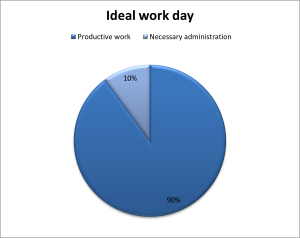
In a perfect world, your workday should look like this:

how productive is your workday

  • 90% of your time on productive work — creating and delivering your products or services.

  • 10% on essential administration — the background tasks that support operations.

The Reality of Workplace Productivity

productivity in a typical workday

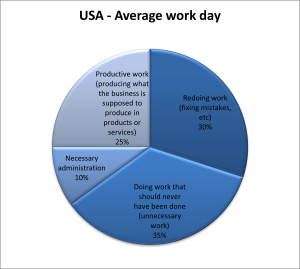
Unfortunately, the reality is very different. Studies show that in many businesses, 65% of the average workday is wasted. That means:

  • Wasted manpower

  • Wasted money

  • Wasted resources and equipment

Here’s the breakdown of this wasted time:

  • 30% is lost redoing work due to mistakes, poor communication, or unnecessary management approvals.

  • 35% is wasted on tasks that don’t support business goals. This is classic “busyness” without productivity.

As a result, only 25% of the day is spent on productive work, and when you add 10% for necessary admin, just one-third of the workday actually contributes to achieving business objectives.

The Cost of Wasted Productivity

Redoing unnecessary work is the worst type of inefficiency — you’re fixing something that should never have been done in the first place. This not only drains resources but also stalls growth, lowers morale, and eats into profit margins.

How Productive Is Your Business?

If you’re honest with yourself, how much of your business day is truly productive? Identifying where time, money, and energy are being wasted is the first step to building a more profitable and efficient business.

Asana – a great online organization tool

I love trying new applications to improve productivity, and was pleasantly surprised when I discovered Asana.com.

Asana was developed to address the frustration of spending too much time doing “work about work.”

The founders, Dustin Moskovitz and Justin Rosenstein, developed this web application to “empower humanity to do great things.”

It works wonderfully for both individual entrepreneurs as well as teams to improve their productivity.

How Asana benefits a small business owner

A small business owner can easily create a project, break it down into tasks and subtasks to be accomplished, and assign these tasks and subtasks to his/her staff. It is a great way to make sure that all staff members are optimally engaged in reaching the goals of the organisation, because you can see at a glance who is working on what, who has too much on their plate, and who can be given more responsibilities.

It is also a great tracking tool of what has been accomplished during a set time period.

An example of how a virtual assistant could use Asana

A virtual assistant can open a Project for every client, and list the tasks, subtasks, and due dates of all that should be accomplished for each client. Every time a new task is received via email or other means, it can be added to the task list for that client. It is easy to see at a glance what needs to be done on a daily basis, as well as for making sure that none of the balls the virtual assistant is juggling fall on the ground. It is also simple to report on what has been accomplished, as the lists and the dates tasks were accomplished are already in an easy-to-use format.

I also like the ability to create repeat tasks for things that have to be done monthly, weekly, or at other preset intervals. Never again do you have to try to remember what needs to be done – it is all there at your fingertips.

If you have people that you outsource work to, you can invite them to specific projects and assign tasks to them as well as track their progress.

Asana can be used for personal projects too

It is not necessary to separate your work life and personal life. You can put all your projects and tasks into one place, so that remembering where you put certain information is never a problem again.

Asana is really a simple, intuitive online productivity tool. I can really recommend it.

Delegation and its consequences

What is delegation?

Delegation is sharing tasks and authority with your team in order to accomplish your goals more quickly and effectively.

What happens if you don’t delegate?

• Your stress levels increase because you have more work than you can cope with
• This leads to unaccomplished tasks on your plate
• Your small business suffers
• Client expectations are not met

What happens if you do delegate?

• You can meet the demands of your business
• You create competence in your employees
• You nurture a sense of responsibility and trust
• Your small business benefits
• Client expectations are met

Why is it so difficult to delegate?

I encounter small business owners daily who find it extremely hard to delegate. They know that it’s the right thing to do, but are scared of losing control of the outcome. They know that they can likely do the task themselves more quickly and better than if they delegate it. They also are afraid that the time it will take to supervise the task will be more than if they simply did it themselves.

I met a business owner with the motto: “If I do it myself, I know it will get done.” This may be true, but he has a huge amount of stress because he tries to do it all himself, and the prospects of his business growing past a one-man show is very slim.

A simple example of the consequences of delegation

A client contacts two small businesses to complete a similar project. The deadlines are tight.

The owner of Company A understands how critical time is. Because time is so tight, he cannot go back later to reconsider or check the work done. He considers that his team have made some mistakes in the past, so he decides to tackle the project himself.

The owner of Company B also understands how tight the deadline is. He also realises that he won’t have much time to review the work done. He therefore sits down and breaks the project into specific parts. He then delegates each part to a team member. This frees him to check the work, since he has also noticed that his team has made some mistakes in the past.

Both the small companies meet the deadline with their projects. However, Company B delivers a more complete and well-thought out project. Company A with its overburdened manager ended up sacrificing quality just to get the job done.

Who will the client chose for the next project?

How to document your procedures

Documenting routine tasks and activities to systemise your business can be a complete nightmare. I often hear the following from clients:

  • They don’t know where to start
  • They don’t know what to do first
  • They don’t know how to write a procedure
  • They don’t know what to put in the procedure to have others successfully follow it
  • They don’t know how detailed the procedure should be

Here are some crucial aspects to consider including when you are documenting your standard operating procedures. These aspects will have a big impact on your ability to systemise your business quicker, easier, and more successfully.

1. Name the procedure correctly

The aim of compiling a procedure is to lead you from point A to point B. It tells you how to do something. A good title will describe this, eg. “How to create an invoice”, “How to answer a sales call”, or “How to sign up a new client”. A name that does not reflect what the procedure is about is not helpful and can cause confusion.

2. Include a description at the top of what the procedure is about

This can be very brief. A sentence will do. The aim is for the person reading the procedure to immediately understand what it is that they are doing, and how it fits into the overall context of the business.

3. List the expected outcome

This tells the reader what they should expect once they have completed all the steps in the procedure. If they don’t reach the expected result, something is not right. Either the procedure is faulty or they have not executed it properly.

4. Create a procedure template

Start out with the same consistent template. Later all the standard operating procedures can fit into a Standard Operations Manual easily. This increases the intellectual property of your business. You will also save a huge amount of time in the long run because you have a business that runs on systems and procedures.

If you have people working for you, they will not only be doing the right things (because you are clear on what the right things are), they will be doing them right (because they are written down) consistently.

If you need help in writing your procedures, please contact Virtual Productivity Solutions.

5 Tips for Writing Effective Standard Operating Procedures

A Standard Operating Procedure is a written instruction that a worker should follow to perform a task effectively.  It communicates who will perform the task, what materials are necessary, where the task will take place, when the task must be performed, and how the person will execute the task.

Here are some ideas to keep in mind when writing standard operating procedures.

1.    Set priorities for which SOPs should be written

You cannot write all the Standard Operating Procedures for every job in a day’s time.  Evaluate which SOPs will have the greatest impact on your bottom line and start with writing them before progressing to the necessary SOPs that may not have an immediate effect on your profit.  Afterwards, write Standard Operating Procedures when new equipment or processes create new work situations.  Also consider new information that may suggest benefits from modifying work behaviours and modify your SOPs accordingly.

2.    People struggle to follow long SOPs

If the Standard Operating Procedure is longer than 10 steps, consider breaking it up into several logical sub-SOPs.  Use flowcharts, diagrams or other methods to simplify the process. Alternatively, you can make the long form SOP a training document to supplement the shorter Standard Operating Procedures to give an overview of what must be accomplished.

3.    Consider who you are writing the SOP for

People differ in terms of age, education, knowledge, skills and experience.  Work cultures also differ.  Determine which writing style and the level of detail needed for the person performing the procedure.

4.    Test the SOP

Get several workers to test the Standard Operating Procedure and give you feedback.  Observe whether the instructions are easy and logical for them to follow, where you may have left out a step, or where more detail is needed.

5.    Review the effectiveness of the SOP

After the Standard Operating Procedure has been in practise for a few weeks, get feedback from the workers and evaluate how effective the SOP is.  Is it accomplishing the goal for which it was written?  Are there ways to improve it?

SOPs form the backbone of an organization.  They are the basis on which you can grow your business.  If you need any help in compiling SOPs, please contact Virtual Productivity Solutions.  We will be happy to help you.