An Overview of Apps to Use to Document Your Standard Operating Procedures

Having your Standard Operating Procedures in place is the only way in which you can ensure consistency and grow your business. However, it is often perceived as a difficult and time-consuming task to compile Standard Operating Procedures, especially in the light of them not staying the same over time due to improvements.

Fortunately, there are some clever people who designed easy ways to compile and maintain Standard Operating Procedures online and on the go.

Process Street

This is a really simple way to manage recurring workflows for your team.

You can set up templates that can be used over and over. In addition, it allows you to track your team’s progress on each workflow so that you can see at a glance.

There are wonderful templates available so that you can set up your processes easily and quickly.

It integrates with over 500 apps, which is great if there are some apps you are already working with.

You can start out with a free plan for up to 5 templates.

SweetProcess

SweetProcess has a 14 day free trial, after which it will cost you $99/month for up to 20 active members.

Like Process Street, it offers you a way to document your procedures and track your team’s progress on them. You can also export your procedures into an Excel or PDF file.

Pipefy

Pipefy offers a little more than Process Street and SweetProcess. Not only can you document and track the progress your procedures with templates provided, you can set up a seamless flow between your different business processes.  You can create templated emails and send them out from Pipefy. In addition, you can create a database for your company’s information. The paid version also offers you the ability to create powerful reports based on your processes.

Small teams (up to 10 users) can sign up for free to begin their workflow controls. However, if you need all Pipefy’s features to grow your business, it costs $30 per user per month. Additional plans for larger teams are available as well.

Of course, if you just want to compile standard operating procedures for reference and easy edits, you can also use tools such as EvernoteWunderlistWorkflowy and Trello.

If you need help in setting up any of the above apps and capturing your workflows and processes, please don’t hesitate to contact me. I’m passionate about setting up and effectively using standard operating procedures!

How to document your procedures

Documenting routine tasks and activities to systemise your business can be a complete nightmare. I often hear the following from clients:

  • They don’t know where to start
  • They don’t know what to do first
  • They don’t know how to write a procedure
  • They don’t know what to put in the procedure to have others successfully follow it
  • They don’t know how detailed the procedure should be

Here are some crucial aspects to consider including when you are documenting your standard operating procedures. These aspects will have a big impact on your ability to systemise your business quicker, easier, and more successfully.

1. Name the procedure correctly

The aim of compiling a procedure is to lead you from point A to point B. It tells you how to do something. A good title will describe this, eg. “How to create an invoice”, “How to answer a sales call”, or “How to sign up a new client”. A name that does not reflect what the procedure is about is not helpful and can cause confusion.

2. Include a description at the top of what the procedure is about

This can be very brief. A sentence will do. The aim is for the person reading the procedure to immediately understand what it is that they are doing, and how it fits into the overall context of the business.

3. List the expected outcome

This tells the reader what they should expect once they have completed all the steps in the procedure. If they don’t reach the expected result, something is not right. Either the procedure is faulty or they have not executed it properly.

4. Create a procedure template

Start out with the same consistent template. Later all the standard operating procedures can fit into a Standard Operations Manual easily. This increases the intellectual property of your business. You will also save a huge amount of time in the long run because you have a business that runs on systems and procedures.

If you have people working for you, they will not only be doing the right things (because you are clear on what the right things are), they will be doing them right (because they are written down) consistently.

If you need help in writing your procedures, please contact Virtual Productivity Solutions.

5 Tips for Writing Effective Standard Operating Procedures

A Standard Operating Procedure is a written instruction that a worker should follow to perform a task effectively.  It communicates who will perform the task, what materials are necessary, where the task will take place, when the task must be performed, and how the person will execute the task.

Here are some ideas to keep in mind when writing standard operating procedures.

1.    Set priorities for which SOPs should be written

You cannot write all the Standard Operating Procedures for every job in a day’s time.  Evaluate which SOPs will have the greatest impact on your bottom line and start with writing them before progressing to the necessary SOPs that may not have an immediate effect on your profit.  Afterwards, write Standard Operating Procedures when new equipment or processes create new work situations.  Also consider new information that may suggest benefits from modifying work behaviours and modify your SOPs accordingly.

2.    People struggle to follow long SOPs

If the Standard Operating Procedure is longer than 10 steps, consider breaking it up into several logical sub-SOPs.  Use flowcharts, diagrams or other methods to simplify the process. Alternatively, you can make the long form SOP a training document to supplement the shorter Standard Operating Procedures to give an overview of what must be accomplished.

3.    Consider who you are writing the SOP for

People differ in terms of age, education, knowledge, skills and experience.  Work cultures also differ.  Determine which writing style and the level of detail needed for the person performing the procedure.

4.    Test the SOP

Get several workers to test the Standard Operating Procedure and give you feedback.  Observe whether the instructions are easy and logical for them to follow, where you may have left out a step, or where more detail is needed.

5.    Review the effectiveness of the SOP

After the Standard Operating Procedure has been in practise for a few weeks, get feedback from the workers and evaluate how effective the SOP is.  Is it accomplishing the goal for which it was written?  Are there ways to improve it?

SOPs form the backbone of an organization.  They are the basis on which you can grow your business.  If you need any help in compiling SOPs, please contact Virtual Productivity Solutions.  We will be happy to help you.

An Example of Why Standard Operating Procedures Should Be Simple

The weather is warming up here in South Africa, and I really feel spring fever approaching.  I love gardening, and decided that this year I’ll fertilize my lawn and garden beds with organic manure.

I contacted various places for prices on their sifted manure, and decided to buy from a company not too far from my house.  Their prices were reasonable, and their only requirement was that I fetch the manure myself.  I have a trailer, so this arrangement suited me, even though it meant several trips to get the amount of manure I wanted.

The procedure at this company is that I ride over a weighing bridge before and after loading the manure in order for them to calculate exactly how much cubic meters I was liable to pay for.

On the first day, I loaded 650 kilograms, and paid R260 for it.  The second day I went, I loaded 600 kilograms and paid R375 for it.  I was quite shocked at the price difference, but didn’t have my first invoice with me to query it.

The third consecutive day I went, I took the invoices with me and asked for an explanation, because I felt certain I was overcharged the second time.

The explanation was that on day 1, one cubic meter was equal to 400 kg.  On day 2, one cubic meter was equal to 500 kg.  The relationship between the cubic meter and kilograms all depends on the moisture level inside the manure.

I felt quite stupid and more than a little confused.  We have not had rain for months.  I’m loading from the same heap of manure each time.  What can cause the moisture level to differ so radically?  I also could not understand that I pay more when there are more kilograms in a cubic meter.

At the weighing bridge I again asked the attendant to explain how they calculate the moisture in the manure.  She launched into a lengthy confusing explanation which can be summarized this way:  Although she is very sweet, she does not exactly understand how it works either.  There seems to be no specific time or set method for determining the moisture level in the manure.  From what I can gather it occurs at the whim of the person responsible.  Other clients also complain, because it is too confusing for the average person to understand.  All I could understand is that on some days I get more manure for my money than on others, even if the capacity of my trailer stays the same.

This time I paid R225 for 600 kilograms. Although I’m delighted to have paid less, I feel cheated.   I don’t feel inclined to support this company again.  I certainly won’t recommend them to anyone.

I would have been a very happy client if I had been charged the same amount for each load.  I would also have been very happy if I had been given a quotation per kilogram, which would have made more sense to me.

What complicated procedures are turning your clients away from your company?  When last did you do an audit into your standard operating procedures to see whether they are meeting the demands of your day-to-day interactions with your clients?

How to Compile Standard Operating Procedures that Work

I often encounter business owners that complain that they have Standard Operating Procedures in their company, but that nobody adheres to them, despite the fact that it was cost-intensive and time-intensive to develop.

There are several myths regarding Standard Operating Procedures which lead to this problem.  Managers think that once a Standard Operating Procedure is developed, it is set in stone.  Employees can feel that these rigid standards can make their jobs boring or demeaning.  They can also feel threatened, thinking that once these standards are in place, they will be replaced by someone cheaper.

Nothing can be further from the truth.

The whole purpose of setting standards is to ensure that there is a consistent way of doing things, and that the business is not conducted in a haphazard way.  It can actually foster continuous improvement and client satisfaction.

Factors to consider when compiling Standard Operating Procedures include:

  • Ensure staff buy-in.

    If you involve the staff and really listen to their ideas, they will feel that they have had a say in the creation of the Standard Operating Procedures, and will be more likely to follow them.

  • Keep it simple.

    Write simple, concise guidelines that are easy to read and understand.  Avoid superfluous language, and just include enough information to get the job done quickly and accurately.  Flowcharts, diagrams, and graphs also enhance quick understanding.

  • Focus on best practices.

    Create systems based on best practices and how to achieve them.  If people know exactly what is expected of them, they are likely to deliver what is expected.  If you give people the information and tools they need to accomplish their job, they are very likely to perform to the best of their ability.

  •  Avoid too much standardization.

    You want to create systems to avoid disorganized and irregular behaviour.  However, you can overdo this.  It is better to build a system that allows for flexibility and customization according to people’s skill level.  This allows them to be creative within the system and creates the desire to continuously improve.

  • Make sure that people understand why there are systems.

    The systems are there to help them control their work better, not to control them.  They must understand their role and functions in order to perform better.

When compiling Standard Operating Procedures, the challenge is to develop a learning organization that will continuously find ways to reduce waste and improve productivity.  Are you ready to meet this challenge?

If you need help in compiling Standard Operating Procedures for your small business, please contact Virtual Productivity Solutions.

Why can Standard Operating Procedures Manuals fail?

When compiling a Standard Operating Procedures Manual, you must keep in mind that people are involved.  You need their cooperation and buy-in in order to achieve a good end result.  They must understand how they will benefit by the whole process.  It is a creative process which involves the cooperation between managers, employees, and advisors.

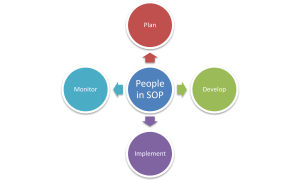
Creating a Standard Operating Procedures Manual is a cyclical process.  It can best be illustrated below.

why standard operating procedures fail

This process includes planning for results, development, implementation, monitoring, and performance feedback.

If you develop a SOP Manual and simply impose it on your employees, your efforts will be futile.  In fact, it is more likely that you will create resentment, rejection of the SOP Manual, and other small acts of sabotage which defeat your purpose.

Everyone who is affected by the SOP Manual should contribute to its development.  If you do not succeed in involving them in the right way, all your efforts are in vain.

Reasons why Standard Operating Procedure Manuals fail to be effective always include the people involved.  Here are examples of the causes for failure

1. Top management is not committed to the process

It is the task of top management, once they decide to create a SOP Manual, to actually follow through and focus the employees’ attention on the goals and benefits of the SOP Manual by communicating with them, and being open to suggestions from all employees throughout the whole process.  If they are not enthusiastic about it, they cannot expect their employees to support it.

 2. Employees mistrust the motives of management

This is a big problem, especially if matters have not been going well between the management and employees prior to the SOP process initiation.  A culture of openness and fairness is far more conducive to producing positive results.

 3. Resistance to change

It can be difficult for some employees to help develop and adapt to new procedures.  They may be very comfortable with the status quo, and not see the need to looking for better ways to do things.

 4. Lack of clear communication

Employees should be informed about the whole aim of creating Standard Operating Procedures before trying to get their input.  They must understand that any input from them is valued, no matter how small it is.  They are, after all, the experts at what they do. They must also feel safe to air problems experienced previously in a procedure, even if it may prove contentious.

What to include in your business Standard Operating Procedures

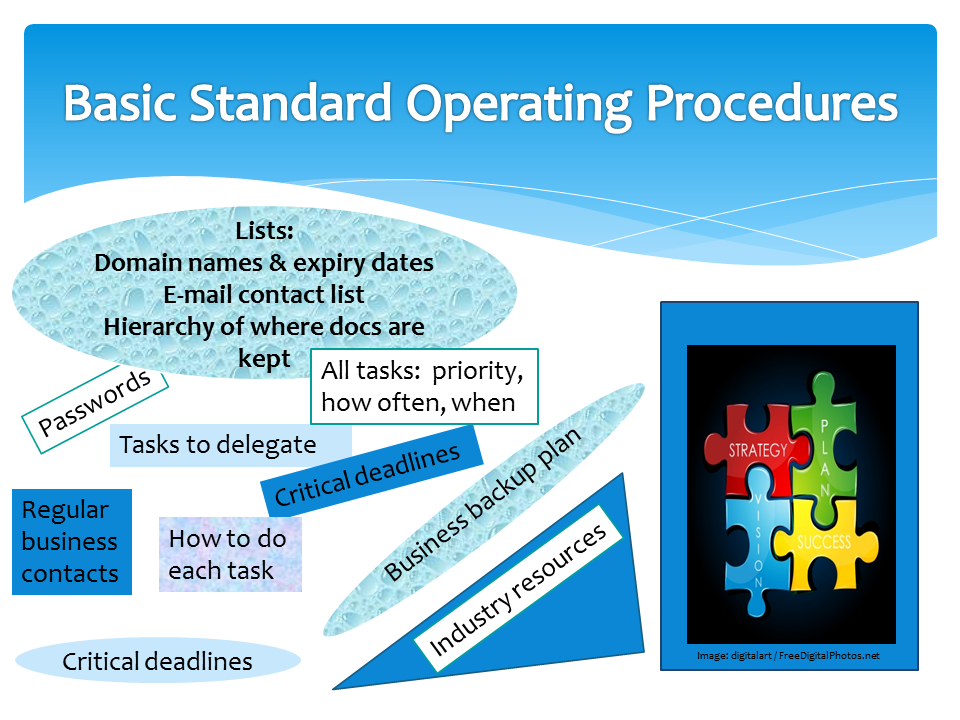
Ever wondered what to include in your small business Standard Operating Procedures?

Below is an infographic detailing the basics.


Once your Standard Operating Procedures are compiled, your business will be more productive, because you will not be re-inventing the wheel with each task.

Do you need help in writing your Standard Operating Procedures?  Please contact Virtual Productivity Solutions.  We can consolidate what you have, suggest ways to do routine tasks, and help you create a solid basis for your business.

Boost your business by creating effective systems


Any business owner will be able to tell you that a business built on effective systems is far more successful than one that is not.

The Business Directory defines a business system as a methodical procedure or process that is used as a delivery mechanism for providing specific goods or services to customers.

Creating effective business systems can be challenging for small business owners.  You may not have the time or inclination to develop systems.  However, if you are serious about business growth, you could consider outsourcing this function to someone that is knowledgeable in this area.  Alternatively, if you have enough in-house staff, you can delegate it to someone that is detail oriented, analytical, persistent and creative, and who does not have a full-time work load.

What would outsourcing your systems management entail?

  • Your key performance indicators will be identified
  • Areas of reduced productivity will be identified
  • Opportunities for improvement will be suggested
  • Your process documentation will be created (checklists, flowcharts, etc) to support the opportunities for improvement
  • You as business owner will approve all processes before they are released
  • Your staff will have an opportunity to contribute to these systems, and also be trained on how to use these systems once they are approved
  • Data will be collected data to monitor your key performance indicators
  • You will receive a reporting scorecard each month on how your business measures up to these key performance indicators.

How to keep on top of your systems development and implementation once you outsource it

  • There needs to be open communication and trust between you and the person working on your system
  • While a lot of the development and detail of creating systems is outsourced, as the business owner you are still responsible and accountable for what happens with regard to systems and processes.
  • A weekly status meeting will go a long way in helping you to catch up with what has been achieved, what has gone well, or areas where challenges or issues have developed.

The results of outsourcing systems development and implementation

  • You will have more time
  • You will increase your competitiveness
  • You will reap the financial rewards of the working systems and procedures
  • Your staff will be happier because they know what they are supposed to be doing
  • Your customers will be more satisfied at your consistent service and output
  • Your business continuity is ensured, because anyone can do the urgent tasks according to the set out procedures if a key staff member is ill or on leave.
  • You will be able to take your business to the next level because your systems and procedures are working.

Next steps

If you would like to find out more about how to improve your business systems, or if you are interested in outsourcing this function, please contact Virtual Productivity Solutions.  We will gladly assist you in this regard.

Just your basic SOP!

This post originally appeared as a guest post on Small Business Fundamentals.

What are Standard Operating Procedures (SOPs)?

One of the most useful systems to streamline your business is having a Standard Operating Procedures manual.  It is a working document (accessible to all staff) that provides detailed instructions on specific recurring work processes.  It communicates who will perform the task, what materials are necessary, where the tasks will take place, when the task must be performed, and how the person will execute the task.

This forms the backbone of an organization.

Standard Operating Procedures should be designed to achieve specific results.  Management must decide what business goals will be achieved through better management with SOPs and how those goals will be measured.

The purpose of SOPs is to assist employees in the daily operations of the workplace and to ensure that critical company policies are followed.  It provides written documentation of best practices.  It also provides the foundation for

  • Job descriptions
  • Employee training
  • Corrective action and discipline
  • Performance reviews

Why does a small business need Standard Operating Procedures?

  • It provides the basis for communication.  Employees work better when they are well-informed, able to perform their jobs autonomously, and are able to feel effective in completing tasks.  Management can feel confident that daily operations are running smoothly.
  • It provides clarity.  It decreases errors and mistakes, conflict, and enhances the feeling of fairness and equity in the workplace.
  • Because of its clarity, it reduces training time, provides direction, and improves work uniformity.
  • It protects employers in areas of potential liability and personnel matters.  A SOP ensures that all employees have access to those policies.
  • It maximises smooth operations.  The ideal is that the SOP will ensure that employees know the policies, rules, regulations, and standardized methods for accomplishing specific tasks and goals.  It also makes it possible for the work to go on when key personnel are not available.
  • It promotes consistency and reliability within the workplace to maintain quality control and assurance.

A few points to consider when compiling Standard Operating Procedures

  • In order to ensure that the Standard Operating Procedures address the goals of the organization, a needs assessment should be conducted to find out which policies and procedures should be included.
  • Standard Operating Procedures should be written as clearly and simply as possible.
  • Various formats can be used to enhance clarity.  For instance, you can use simple steps, hierarchy steps, graphic images, or flow charts.
  • The level of detail in SOPs should provide adequate information to keep performance consistent while keeping the procedures from becoming impractical.
  • Drafts should be made and tested before a SOP is released for implementation.
  • Make the document rigid enough to document the rules of the organization, but flexible enough to be able to be followed easily.
  • Get the input of the staff that actually do the job.  People are much more likely to accept and use a SOP if they feel a sense of ownership in it.

Revision of Standard Operating Procedures

Once the SOP has been approved, a schedule should be set for reviewing it.  Every SOP should be reviewed annually, or, at a minimum, bi-annually to make sure that the practices and policies are still relevant and have not changed.

Does your business have Standard Operating Procedures in place?  Do you need to revise your documentation to make is more up-to-date and relevant?  Contact Virtual Productivity Solutions to get your business processes mapped out.

5 Key Benefits of a Standard Operating Procedures Manual

One of the most useful systems to streamline your business is having a Standard Operating Procedures (SOP) manual.  This manual lists the all the tasks that are essential for your business success, how to do these tasks, and who is responsible for the tasks listed.

This sounds useful, but are there specific measurable outcomes if you have a SOP manual in place?  The answer is a very definite YES.

Your productivity improves, and as a small business owner, you need to be highly productive to succeed.  Five benefits are listed below.

Reduced learning curve/training time for new employees

When someone is new on the job, your well-written and researched SOP can be a lifeline to them to be able to know how things work.  For instance, you can ask your new employee to make all the arrangements for you to organize and attend a workshop in another city.  By referring to the SOP, your new employee will know exactly which travel agency you use with their contact details, which type of car to hire/service to use, how many quotes to get regarding the venue, how to communicate with the workshop delegates, etc. without having to ask you about it all.  It’s a great time-saver and confidence booster for the new employee.

Ensured business continuity

When a key staff member is on leave or not in the office for some reason, work does not have to stand still.  By referring to the SOP someone else can take over the urgent tasks and do them correctly the first time.

Standardized processes

The SOP makes it easy to find out what policies and procedures are in place to handle repetitive situations/tasks.

Delegating tasks becomes a no-brainer

A good SOP will include the organogram of the business, as well as have a short job description and contact details for each staff member. If you need to delegate a certain task, you can see at a glance who will be able to help you or advise you.  You can stop micromanaging, as it is clear who is responsible for what.

Ensure that your clients are getting the best possible experience with you

Because there is a standard way of dealing with client queries, refunds, promotions, follow-up etc., you can make sure that each client is treated fairly and equally, enhancing their interactions with you.  You thus provide the best possible client service.

A SOP is a living document, which is subject to change.  (It is good to review it quarterly). It is therefore useful to have it in electronic format on a web-based collaborative system so that all employees have access to the latest version.

Do you need to put together a clear and straightforward SOP, compiled in simple language to convey practical information?  Please don’t hesitate to contact Virtual Productivity Solutions to help you put it together.  Your business will thank you for it.